
Key Takeaways
- • The Prairie Capital Summit in downtown Fargo drew 244 registered attendees, including 98 entrepreneurs (up 53% year over year) and 52 investors (up 27%), according to organizer Emerging Prairie.
- • North Dakota venture capital funding rose 66% in the first half of 2026 versus the same period in 2025, but 61% of that increase came from a single $10 million Series B round raised by Fargo-based cattle technology company 701x, which was funded exclusively by individual investors.
- • Speakers at the summit said investors back teams they trust: Resilience VC led Grand Forks-based Tugboat's $3 million seed round after founder Aaron Mooney contacted more than 200 investors, and Brown Venture Group's Jerome Hamilton said his firm completes extensive team due diligence before the first pitch call.
- • Panelists advised founders to expand to coastal markets only when customer density or a solid business case justifies it, noting that Midwest physical-industry concentrations such as agriculture and medical devices can be an advantage.
- • Chipp.ai CEO Scott Meyer said true AI-first transformation remains the exception, with roughly half of attendees reporting an autonomous agent working for them at that moment.
Summary
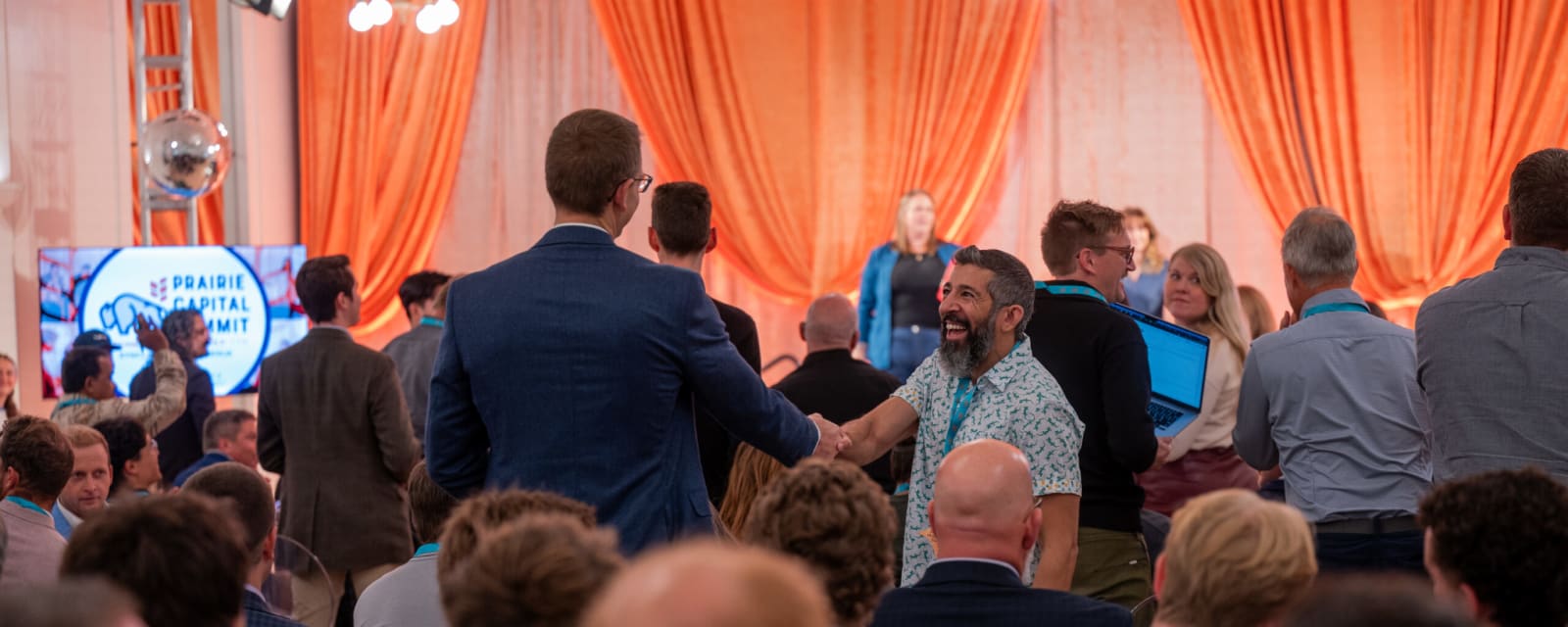
The Prairie Capital Summit, which returned to downtown Fargo this month, connects founders, investors, resource partners and students across North Dakota's startup ecosystem. Organizer Emerging Prairie reported that among 244 registered attendees at the Synclaire Events Venue, 98 identified as entrepreneurs, up 53% from last year, and 52 identified as investors, up 27%. The article places this against a backdrop in which North Dakota ranks in the bottom 10 states for new business formation, though business applications in the state hit a record high in August according to Census Bureau data compiled by the St. Louis Fed. Applications over the prior 12 months were up 14% year over year. The article notes that one event's attendance is a small sample.
A recurring theme was that relationships still close deals despite AI disruption. Aaron Mooney, COO and co-founder of Grand Forks-based insurance technology startup Tugboat, said he contacted more than 200 investors before partnering with Resilience VC, which went on to lead Tugboat's $3 million seed round. Tahira Dosani, co-founder and managing partner at Resilience VC, said she looks for founders who can articulate a vision beyond their product. Panelists also stressed that investors view team trust as central. Capital concentration is a visible trend in the state: venture funding rose 66% in the first half of 2026 over the same period in 2025, with 61% of the gain tied to 701x's $10 million Series B. Mike Asem, founding partner at Chicago-based M25, said founders must be self-aware and honest about their blind spots, and Jerome Hamilton of St. Paul-based Brown Venture Group said his firm completes substantial team due diligence before taking the first call.
On expansion, gener8tor 1889's Ben Stanley said founders should follow their customers and pursue coastal offices only where there is customer density or a solid business case. Megan Baniecke of South Dakota's Homegrown Capital said video calls make it easier to remain in the Midwest and travel when personal contact is needed. Kim Patel, a JPMorgan Chase vice president focused on Midwest startup banking, said the region's concentration of physical industries such as agriculture and medical devices could become an advantage as venture capital expands beyond software.
On AI, Stanley said investments once considered unfit for venture backing are increasingly entering target range, while Baniecke emphasized that a vibe-coded prototype still must be backed by demonstrated grit. Scott Meyer, CEO and co-founder of Fargo-based Chipp.ai, said nearly every attendee used AI daily and about half had an autonomous agent working for them, but that true AI-first transformation remains the exception. He cited client Valor Victoria, a West Fargo logistics startup that replaced outsourced development and support with agentic infrastructure, and predicted AI-first businesses will become commonplace within 10 to 15 years.
Go deeper than the headline
Research every firm in this story, track the ones that matter and get the daily briefing — free for 7 days.