
Key Takeaways
- • Bitwise projects that U.S.-listed Bitcoin ETFs could purchase more than 100% of all new Bitcoin issuance in 2026, signaling unprecedented institutional demand dynamics with supply constraints as a potential tailwind for Bitcoin pricing.
- • Lower ETF fees and expanded access mechanisms are positioned as structural catalysts that could support Bitcoin price appreciation by democratizing institutional participation and reducing friction costs for capital allocation into spot Bitcoin products.
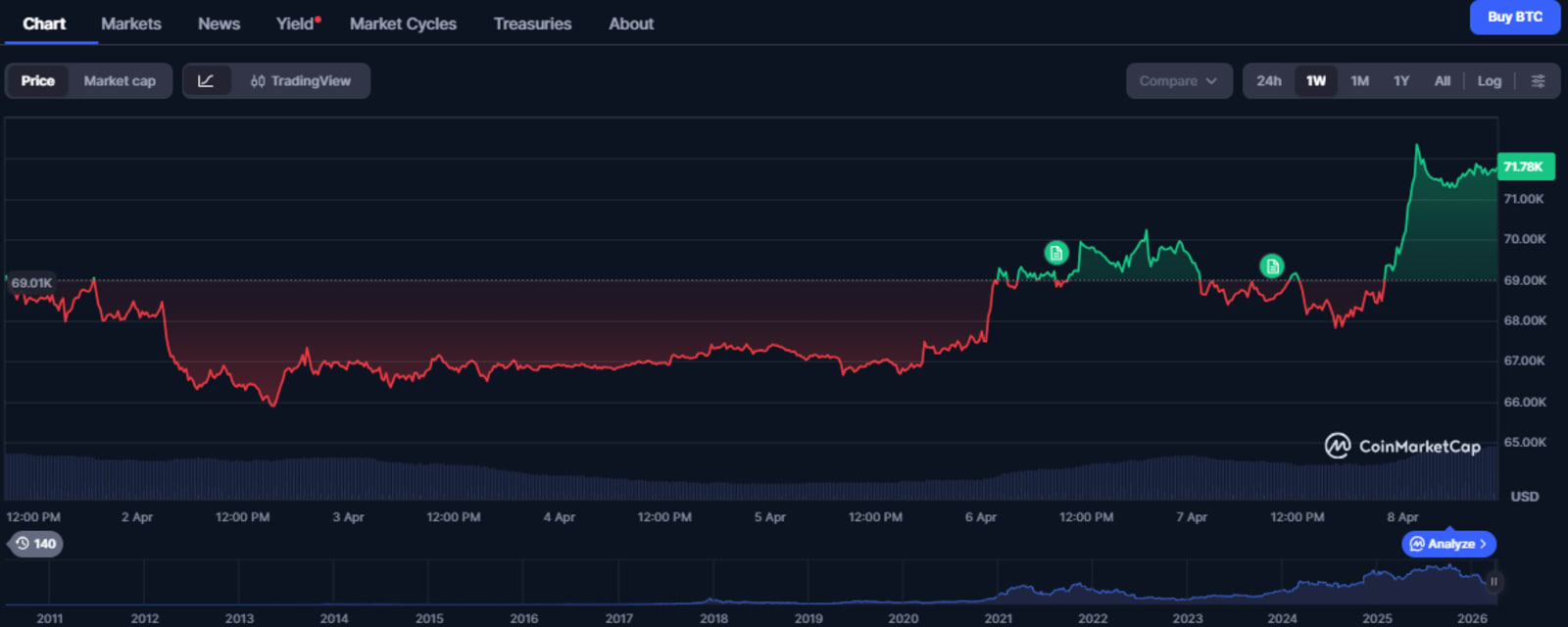
- • Bitcoin trading pressure persists with prices struggling to maintain support above $67,000 (trading near $66,000 as of early April 2026) following a March peak near $75,000, reflecting broader market uncertainty and declining global risk appetite.
- • Coinbase Global received a policy boost from the Trump administration's pro-crypto stance on banking regulation, though Barclays simultaneously downgraded the stock to Underweight on weak trading volumes, highlighting mixed signals in the institutional crypto ecosystem.
- • Institutional demand dynamics remain strong despite near-term price volatility, with ETF inflows supporting the asset class even as broader macroeconomic headwinds create directional uncertainty for Bitcoin and the wider cryptocurrency market.
Summary
Bitcoin's pricing dynamics in 2026 are increasingly shaped by institutional capital flows through spot ETFs, which have fundamentally altered the supply-demand equation for the asset. According to Bitwise's projections, U.S.-listed Bitcoin ETFs are positioned to purchase more than 100% of all new Bitcoin issuance during 2026—a structural development with no historical precedent. This demand-supply imbalance suggests that ETF accumulation alone could absorb the entire new supply of bitcoins generated through mining, creating a potential scarcity dynamic that could support price appreciation independent of retail sentiment or speculative positioning.
The pricing case for Bitcoin is further supported by the ongoing consolidation and fee compression in the spot ETF ecosystem. Lower management fees and expanded institutional access mechanisms reduce the friction costs for large capital allocators to gain Bitcoin exposure, widening the addressable market beyond traditional cryptocurrency-native investors. This structural shift toward mainstream institutional participation through regulated, low-cost vehicles creates a medium-term tailwind for Bitcoin as alternative asset allocation frameworks increasingly incorporate digital assets as portfolio components.
Current price action, however, reflects near-term headwinds that have offset some of this structural support. Bitcoin has traded under pressure in early 2026, struggling to maintain levels above $67,000 following a March peak near $75,000. This weakness is attributed to declining global risk appetite and broader macroeconomic uncertainty rather than crypto-specific dynamics, indicating that Bitcoin pricing has become increasingly correlated with systemic financial conditions. Markets are bracing for volatility gaps and sustained stress tests on global markets as geopolitical tensions persist.
The institutional ecosystem shows mixed signals. While the Trump administration has signaled pro-crypto policy positions supporting banking access for cryptocurrency companies like Coinbase, Barclays simultaneously downgraded Coinbase Global to Underweight from Equalweight, citing weak trading volumes and reducing its price target to $140 from $148. This divergence—positive policy tailwinds coupled with deteriorating operational metrics—reflects the complex backdrop in which ETF-driven Bitcoin demand coexists with structural weakness in cryptocurrency trading platforms' core businesses. The combination of strong ETF flows, fee compression, and institutional demand remains architecturally supportive for Bitcoin pricing, though near-term volatility and macro-driven price pressure may persist.
Go deeper than the headline
Research every firm in this story, track the ones that matter and get the daily briefing — free for 7 days.