
Key Takeaways
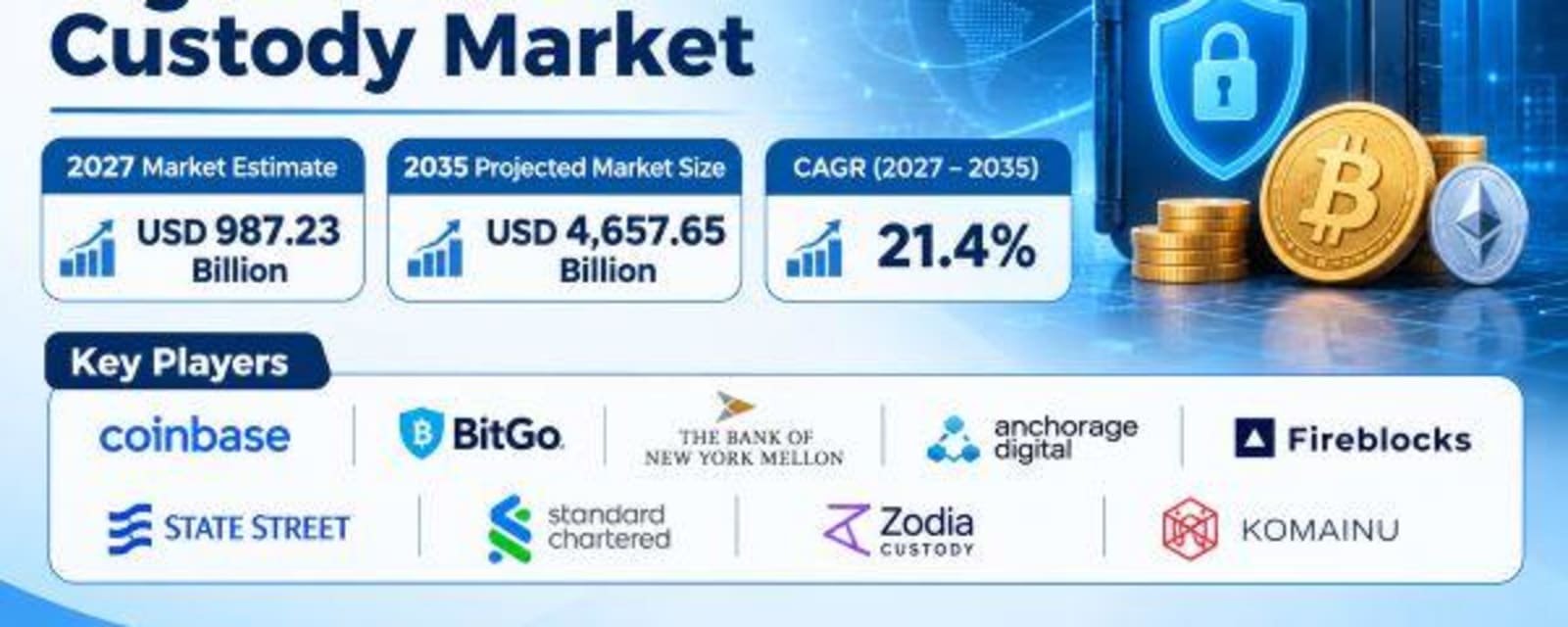
- • Polaris Market Research projects the global digital asset custody market to grow from USD 812.00 billion in 2026 to USD 4,657.65 billion by 2035, a 21.4% CAGR for 2027-2035, according to a press release published on openPR.
- • Cold storage held 59.2% of 2027 value, while warm storage is the fastest-growing storage type at 24.8% CAGR.
- • Cryptocurrencies held 57.3% of assets; tokenized securities and real-world assets are forecast to grow at 27.8%.
- • North America led with a 39.9% share in 2027 but is the slowest-growing region at 19.4%; Asia Pacific is projected to grow fastest at 24.4% CAGR.
- • Clearer custody rules and bank entry, including BNY's USDC custody listing and the SEC's October 2026 custody rule proposal, are the primary drivers, while fragmented national rules raise costs and favor larger players.
Summary
Polaris Market Research estimates the global digital asset custody market, which measures assets held by third-party custodians safeguarding private keys, was valued at USD 812.00 billion in 2026 and at USD 987.23 billion in 2027. The firm forecasts the market will reach USD 4,657.65 billion by 2035. The market excludes assets held in personal wallets and custody fee income. The report, distributed via openPR, covers storage type, asset type, end user and region.
By segment, cold storage led storage types with 59.2% of 2027 value, while warm storage is forecast to grow at 24.8% and hot storage at 23.8%. Cryptocurrencies accounted for 57.3% of assets, while stablecoins are growing at 24.5% and tokenized securities and real-world assets at 27.8%. Financial institutions and institutional investors held 39.0% of end-use value and crypto-native firms and exchanges 37.8%, with corporates and public sector organizations growing at 26.0%.
Regionally, North America held a 39.9% share in 2027 but is the slowest-growing region at 19.4%. Europe held 26.8% and is growing at 20.9%, led by the UK, Germany and Switzerland. Asia Pacific is forecast to post the fastest CAGR at 24.4%, with Singapore, Japan and China as large markets and India growing at 33.8%. Latin America held 4.1% and the Middle East and Africa 3.6%.
Polaris identifies clearer custody rules allowing advisers, banks and funds to use qualified custodians, along with bank and asset manager adoption of custody, staking and tokenized products, as primary growth drivers. Federal trust charters are giving crypto-native custodians bank-like standing, and tokenized deposits and stablecoin reserves are widening the custody base. Fragmented national rules and localization requirements are the main restraint, raising operating costs and favoring larger players. The report expects bank entry and possible consolidation to shape the competitive field through 2035.
Profiled companies include BitGo, BNY, Anchorage Digital Bank, Fireblocks, State Street, Standard Chartered, Zodia Custody, Komainu, Fidelity Digital Assets, Gemini Trust Company, Copper Technologies, Hex Trust and Ledger Enterprise. Recent developments cited include State Street's January 2026 digital asset platform for tokenized funds, BNY adding USDC as the first stablecoin on its custody platform in June 2026, a August 2026 BNY and Galaxy agreement to add staking support subject to regulatory review, and the SEC's October 2026 proposed custody rule amendments for registered investment advisers and funds holding crypto assets.
Go deeper than the headline
Research every firm in this story, track the ones that matter and get the daily briefing.